The Phygital Marketing Framework
Owning the Future of Connected Customer Experience
Service is personal. Systems are not.
Walk into most brick-and-mortar stores today and something strange happens: all the precision of modern marketing disappears. The same brand that knows exactly which ad you clicked, what you left in your cart, and how many days since your last purchase has absolutely no idea you just walked through their front door.
Digital marketing has spent the last decade building an incredible identity infrastructure. Brands can find their customers anywhere online, personalize at scale, and measure everything. But the moment that same customer steps into a physical location, the lights go out. Visits are anonymous. Behavior is invisible. The relationship that took months to build online essentially resets.
That is the identity gap. And for most retail, restaurant, and hospitality brands, it is quietly costing them more than they realize.
This guide introduces the Phygital Marketing Framework: a model for connecting physical and digital customer experiences into one unified operating system. It is built for marketing, CX, and revenue leaders who are done leaving their best channel in the dark.
The In-Store Identity Gap
Walk into most brick-and-mortar stores today and something strange happens: all the precision of modern marketing disappears. The same brand that knows exactly which ad you clicked, what you left in your cart, and how many days since your last purchase has absolutely no idea you just walked through their front door.
Digital marketing has spent the last decade building an incredible identity infrastructure. Brands can find their customers anywhere online, personalize at scale, and measure everything. But the moment that same customer steps into a physical location, the lights go out. Visits are anonymous. Behavior is invisible. The relationship that took months to build online essentially resets.
That is the identity gap. And for most retail, restaurant, and hospitality brands, it is quietly costing them more than they realize.
This guide introduces the Phygital Marketing Framework: a model for connecting physical and digital customer experiences into one unified operating system. It is built for marketing, CX, and revenue leaders who are done leaving their best channel in the dark.
The Phygital Model
Phygital marketing is not a new channel or a loyalty app or a piece of hardware. It is what happens when physical and digital customer experiences stop running in parallel and start working as one system — one that finally gives brick-and-mortar the same identity infrastructure that digital has had for years.
The model is built on four pillars:
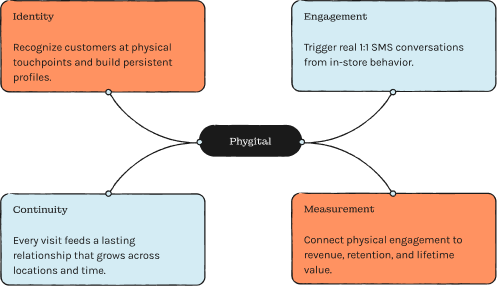
Real-Time Customer Recognition
Every digital marketing system worth anything is built on identity. Take that away and personalization falls apart, attribution becomes guesswork, and lifecycle marketing loses its foundation. Physical environments deserve the same standard. Most are nowhere close.
Why Traditional Methods Fall Short
Email capture at POS, loyalty sign-up forms, app download prompts — these have been the go-to solutions for years, and they share the same fundamental flaw: they put the burden on the customer. They are slow, require staff to execute, and only work on the small percentage of shoppers who are already highly motivated. Everyone else walks out the door unnamed.
The Phygital Cookie
The Phygital Cookie is Sotto's tap-to-connect technology. A small device placed within the store environment that customers engage with by tapping their phone — the same motion as a contactless payment. No app. No QR code. No form.
The whole thing takes a few seconds. The customer opts in and immediately enters a 1:1 SMS conversation with the brand. The visit is captured, the profile is created, and the relationship starts — all before they have left the store. It works because timing is everything. Customers who engage in-store are already invested in the brand at that moment. Intent is high, friction is low, and participation rates reflect that.
Building Rich Profiles Through Two Data Streams
Recognition is the starting point. What gets built from there is where the real value lives:
- First-Party Data: the behavioral record — visit history, transactions, engagement patterns, and signals that build over time.
- Zero-Party Data: the explicit layer — preferences, purchase intent, and context that customers share directly through conversation.
Zero-Party Data: the explicit layer — preferences, purchase intent, and context that customers share directly through conversation.
Connected Engagement
Recognition opens the door. Engagement is what you do once you are in.
Most brands are still running a transactional model. Customer buys something, gets a receipt, maybe receives a generic promotional email a few days later. The interaction ends at the register. There is no follow-up that feels personal, no ongoing dialogue, no sense that the brand remembers who they are or why they came in.
Phygital engagement changes that. Every in-store moment becomes the beginning of a conversation, not the end of a transaction.
Why SMS Works Here
People are already texting. It is the most personal, immediate channel available — and it does not require an app or a login. When a customer opts in through the Phygital Cookie, they enter a real 1:1 conversation with the brand. Not a blast, not a drip sequence — an actual exchange that adapts based on what they share.
That is a meaningful difference from traditional SMS marketing, which is really just bulk messaging dressed up with a first name. Sotto is built for real dialogue at scale.
What that looks like in practice:
- Post-visit follow-up tied to what the customer browsed, tried, or bought — sent while the visit is still fresh
- Personalized outreach that connects in-store behavior to what you already know about the customer
- Loyalty reinforcement that recognizes visit frequency and spend milestones in real time
- Messaging that uses in-store signals to move customers naturally from new to loyal
Every conversation makes the profile richer, which makes the next interaction more relevant, which makes the customer more likely to come back. Zero-party data builds through the relationship itself — no surveys, no forms, no friction.
Measurement and Revenue Impact
Brick-and-mortar has always been the black box of marketing. Brands can trace a digital ad to a click to a purchase with incredible precision. But ask what a store visit did for retention — or how in-person engagement influenced lifetime value — and most organizations genuinely cannot tell you.
That is not an analytics problem. It is an identity problem. When visits are anonymous, they cannot be measured. And when they cannot be measured, they cannot be optimized.
Phygital marketing changes the equation. Once in-store interactions are connected to real customer profiles — through opt-ins captured by the Phygital Cookie and enriched through ongoing SMS conversations — physical engagement becomes measurable using the same frameworks brands already apply to digital.
What that unlocks:
- Cross-channel attribution that actually works: physical and digital attribution in the same model, finally.
- Retention tied to real behavior: understand exactly how visit frequency drives repeat purchase rates.
- Experience as a performance variable: when you can measure in-store engagement against LTV and NPS, store design stops being an aesthetic question and becomes a strategic one.
- Organizational alignment: store operations and marketing teams working from the same data, toward the same goals.
When in-store performance is measurable, it is optimizable. Stores stop being cost centers that require justification and start being performance channels that prove their worth — in the same terms as any digital investment.
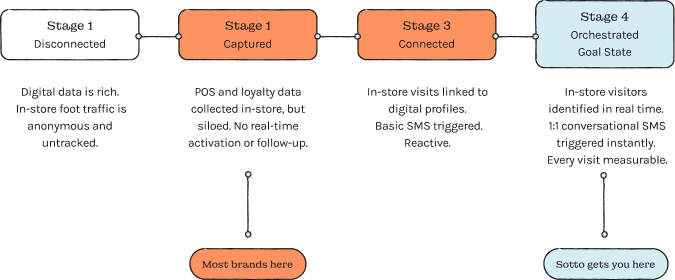
The Phygital Maturity Curve
Most organizations do not get to a fully connected physical-digital operation in one move. They progress through stages. Knowing where you are is the starting point for building a realistic path forward.
Phygital in Practice: Across Industries
The framework applies wherever customer relationships span physical and digital environments. The mechanics look different by vertical, but the logic is the same: identity, engagement, continuity, measurement.
Retail
- Recognize customers at key in-store moments via the Phygital Cookie
- TurnTrigger post-visit 1:1 SMS conversations tied to what customers browsed or bought in-store dining visits into ongoing SMS conversations that keep the relationship active between visits
- Connect store visit data to customer profiles for a unified record
- Attribute store visit impact to downstream revenue and lifetime value
Restaurants and QSR
- Recognize guests across locations using persistent digital identity
- Turn dining visits into ongoing SMS conversations that keep the relationship active between visits
- Tie visit frequency and order patterns to individual profiles
- Reengage customers automatically when visit cadence drops off
Hospitality and Hotels
- Recognize guests across on-property touchpoints beyond check-in
- Build engagement that extends well beyond booking confirmations
- Develop genuine long-term relationships between travel occasions, not just during them
The Future of Phygital and How Sotto Leads
Customer expectations have already moved past what most brands can deliver. People do not think in channels. They experience one brand — and they expect that brand to know them, remember them, and show up the same way whether they are on their phone or in your store.
Most brands are not there yet. And the gap between expectation and execution is getting harder to ignore.
The brands that close the identity gap first will not just deliver better experiences. They will build a structural advantage that is genuinely hard to replicate — because the data asset that comes from years of phygital engagement compounds. It gets more valuable the longer you build it.
What that advantage looks like:
- Better retention and more repeat visits: customers who feel recognized come back more often and spend more when they do.
- Higher lifetime value: engagement that extends beyond the transaction keeps customers in the relationship longer.
- Real marketing efficiency: when physical and digital are connected, spend goes where it actually works.
- A stronger owned channel: every in-store opt-in is a direct relationship that does not depend on a paid platform or a third-party algorithm.
- A real competitive edge: most competitors are still treating their stores as anonymous environments. The brands that fix that will stand apart in ways customers actually notice.
How Sotto Makes It Happen
Sotto is the phygital engagement platform built for brands that operate where physical and digital meet. At the center is the Phygital Cookie — tap-to-connect technology that turns any in-store moment into a frictionless opt-in. No app. No QR code. No form. Just a tap, and the relationship starts.
- Instant, frictionless opt-in: anonymous foot traffic becomes known, consented customer profiles in seconds.
- Conversational SMS at scale: triggered by in-store behavior, personalized to the individual, and built for real two-way dialogue.
- Zero-party data through conversation: preferences and intent collected naturally through messaging, not forms or surveys.
Phygital marketing is not a trend. It is the direction customer relationships are heading — and the brands that build this infrastructure now will be the ones defining what great looks like in five years.
Hospitality is human. Sotto helps it stay that way.
Sotto’s Agentic Lifecycle Marketing platform redefines what automation can mean for modern teams — smarter campaigns, richer data, and complete transparency.
Your team gains time. Your guests gain connection. Your brand gains loyalty that lasts.